
24 Jan, 2026
2 min read
Astronomers Discover Largest Known Rotating Cosmic Structure: A Massive Spinning Filament of Galaxies
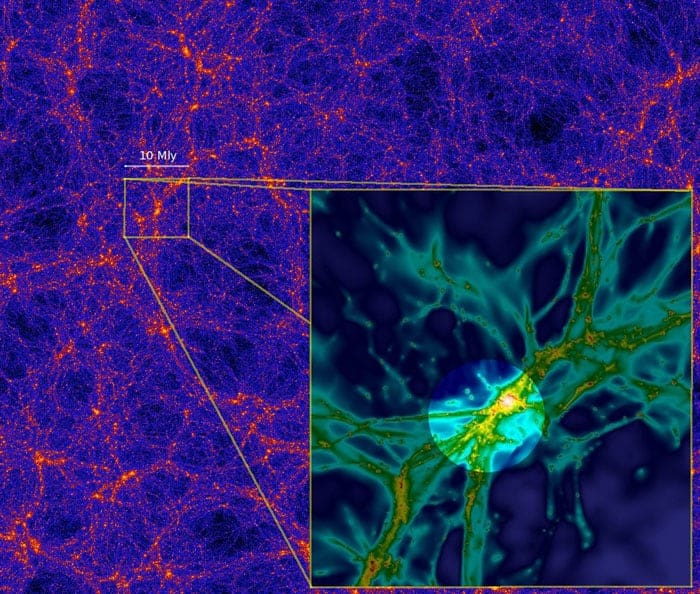
Scientists have detected the largest rotating structure ever observed in the universe—a colossal filament consisting of hundreds of galaxies, gas, and dark matter, forming part of the cosmic web’s vast architecture. Situated approximately 140 million light-years from Earth, this gargantuan cosmic thread spans about 50 million light-years in length and 117,000 light-years in width, dwarfing the Milky Way galaxy in scale.
Utilizing data from South Africa’s MeerKAT radio telescope array, comprising 64 interconnected satellite dishes, researchers confirmed that this filament exhibits a coherent rotational movement. Galaxies on either side of the filament’s central axis were found to be moving in opposing directions, resulting in a rotational velocity near 246,000 miles (396,000 km) per hour.
Madalina Tudorache, an astrophysicist at the University of Cambridge and co-lead author of the study published in Monthly Notices of the Royal Astronomical Society, explained, "The universe on large scales is structured as a network called the cosmic web, composed of dense clusters, empty voids, and filamentary strands connecting these regions."
The filament captures nearly 300 galaxies of diverse sizes alongside vast amounts of gas and dark matter—the elusive substance believed to constitute around 27% of the universe’s mass. Unlike ordinary matter that emits or interacts with light, dark matter is invisible but detectable via its gravitational influence.
Lyla Jung, co-lead author and astrophysicist at the University of Oxford, described the filament’s dynamics by drawing an analogy to a teacup amusement park ride: "Each galaxy spins individually like a teacup, but the entire filament itself also rotates, similar to the teacup platform spinning as one. This unique dual rotation characterizes the filament’s structure."
This landmark detection marks the largest individual rotating structure recognized to date. Although theoretical models suggest other rotating cosmic filaments may exist with even greater dimensions, current observational technology has yet to reveal them.
Astrophysicists continue to study the universe across all scales—from fundamental particles like neutrinos to vast galactic assemblies and ultimately the immense networks that connect them. Tudorache emphasized, "With advancements in radio and optical surveys, our capability to uncover such enormous cosmic structures is rapidly improving, promising deeper insights into our universe’s fundamental composition and evolution."
Recommended For You

Nearly 10 Kilograms of Suspected Marijuana Seized at NAIA Terminal 3
Jan 24, 2026
Visitacion Quibuyen

Catriona Gray Leads Prayer Against Corruption at Trillion Peso March
Jan 24, 2026
Apolinario Tiamzon

Diesel Prices to Drop by P2.90 per Liter in December Amid Mixed Fuel Price Adjustments
Jan 24, 2026
Visitacion Quibuyen

Southeast Asia Floods and Landslides Claim Over 600 Lives Amid Ongoing Relief Efforts
Jan 24, 2026
Gregoria Sumulong